
This guide walks through eight shifts that the latest research supports. Each one comes with sourced numbers, a plain-English explanation and a practical next step.
The direct answer: the biggest AI marketing trends of 2026 are answer-first search, supervised AI agents, a flood of similar content, personalization at scale, a widening trust gap, changing team roles and a push to measure real value instead of tool usage. Teams that combine AI speed with human proof and honest disclosure are in the strongest position.
✅ Key Takeaways
- Using AI is now the baseline. Getting measurable value from it is the hard part.
- AI summaries in search can reduce clicks, so citations and brand mentions matter more.
- Most teams keep humans in the loop when they deploy AI agents.
- Generic AI content blends together. Original experience and data stand out.
- Consumers are more skeptical of AI-made ads than advertisers expect.
A note on “firsthand”: the data in this article comes from the published surveys and studies linked throughout. Each trend also has a “Your firsthand note” box. Fill those in with what you have personally observed in your own campaigns, clients or tests. If you cannot add real observations, change the post title to something like “8 AI Marketing Trends Shaping 2026 (Backed by Data)” so it stays honest.
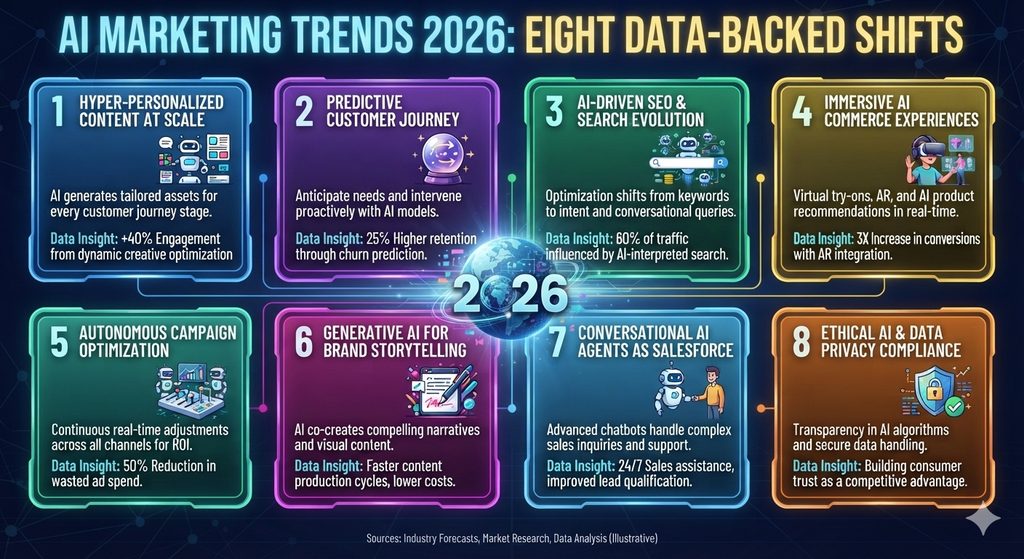
Table of Contents
How to Read AI Marketing Trends Data Without Being Misled
Numbers make AI marketing trends feel solid, but surveys differ in quality. A few habits help you judge them.
- Check who ran the survey. Software vendors often study their own customers, which can skew results.
- Check the sample. A survey of 408 consumers is not the same as a study of 68,879 searches.
- Check the date. Some figures below come from 2025 research, and I label them as such.
- Treat self-reported “use” carefully. Saying you use AI is not the same as getting results from it.
- Compare more than one source. When different studies point the same way, trust grows.
I link to the original source for every figure so you can check it yourself. Where I could only find a summary of a report, I say so.
Why These AI Marketing Trends Matter for Small Teams
Large brands dominate headlines, but AI marketing trends affect small teams just as much. In some ways they affect them more.
A small team has fewer people to absorb mistakes. It also has more to gain, because AI can handle drafting, reporting and routine tasks that once needed extra hires.
That is why understanding AI marketing trends early pays off. You can choose a few tools carefully instead of buying everything at once.
Three Advantages Small Teams Have
- Speed: you can test an idea this week without a long approval chain.
- Closeness to customers: your real conversations are the original material that generic AI content lacks.
- Accountability: a person who knows the brand can review every piece of output.
Use these strengths when you read the AI marketing trends below. Large surveys describe averages, but your own tests will tell you what works for your audience.
A Simple Framework for Judging AI Marketing Trends
Every year brings a new wave of AI marketing trends, and not all of them deserve your budget. A quick three-question test helps you decide.
- Is it real? Look for evidence from more than one independent source, not just a vendor’s launch post.
- Is it relevant? Ask whether your audience actually behaves this way. A trend in enterprise software may not apply to a local service business.
- Is it testable? Choose trends you can try cheaply for 30 days and measure.
Run each of the AI marketing trends below through this test. Those that pass all three questions deserve a place in your plan, and the rest can wait.
This habit also protects you from hype. Many AI marketing trends sound exciting in a keynote but fall apart when they meet your real customers and your real data.
Trend 1: AI Is the Baseline, Value Is the Question
The first of the AI marketing trends is the simplest: almost everyone uses AI now. HubSpot’s 2026 State of Marketing findings report that 86.4% of marketing teams use AI in at least a few areas. The most common heavy uses are content creation, media creation and admin automation.
Epsilon’s 2026 benchmark study went further. It reports that every marketer surveyed uses AI, and 91% call it very or extremely valuable. Yet 45% name data quality as their top challenge.
What This AI Marketing Trend Means for You
Having AI tools is no longer an advantage. The advantage comes from clean data, clear goals and good judgment about where AI helps.
Next step on this AI marketing trend: list the three marketing tasks where AI saves you the most time. Then check whether the output is actually better, not just faster.
Your firsthand note: [Add 2 to 3 sentences about how you or your team actually use AI, what improved and what did not.]
Trend 2: AI Search Rewrites How People Find Brands
AI search is changing what happens after a person types a question. Instead of ten links, they often see a written summary first.
Pew Research Center studied the browsing of 900 U.S. adults in March 2025. In that study, people who saw an AI summary clicked a traditional result link in 8% of visits, compared with 15% when no summary appeared. Clicks on the sources cited inside the summary were rare, at about 1% of visits.
This is 2025 data, and AI search has kept changing. Still, the direction matters for anyone who depends on organic traffic.
How Marketers Are Responding to This AI Marketing Trend
HubSpot’s data suggests about 40.6% of marketers are updating their SEO strategy for AI-powered search. Google’s own guidance says its AI features still build on its core search systems, so crawlable, useful pages remain the foundation. See Google’s AI features guidance.
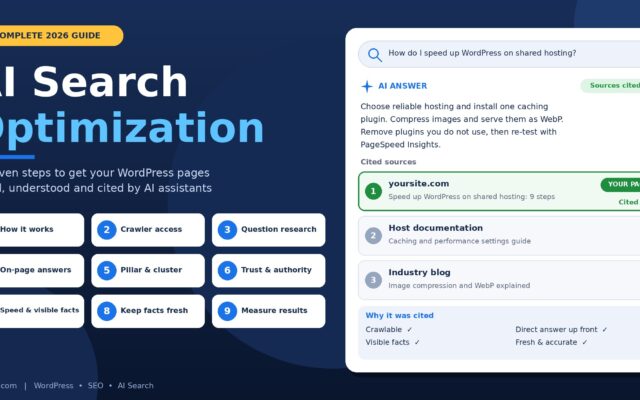
Next step on this AI marketing trend: write pages that answer one question clearly, with specific facts near the top. Our guide to AI search optimization covers this step by step.
Your firsthand note: [Describe any change in your own traffic, clicks or impressions, and which pages gained or lost.]
Trend 3: AI Agents Move From Demos to Supervised Work
AI agents go a step beyond chatbots. They can plan and carry out tasks across tools, such as drafting a campaign, pulling reports or routing leads.
Adoption claims vary. HubSpot’s figures show that 19.2% of marketers already use agents to automate initiatives end to end. The Martech for 2026 report, by Scott Brinker and Frans Riemersma, was summarized by Let’s Data Science as finding that 90.3% of teams use agents but only 23.3% run them in full production.
These numbers look far apart because “using” and “running at scale” are different things. The gap between pilots and production is the real story.
Humans Stay in the Loop
A separate developer-focused survey, covered by PPC Land, found that only 4% of teams let agents act with no human approval. That survey covered builders and technology leaders, not only marketers, so treat it as a guide to the mood, not a marketing statistic.
Next step on this AI marketing trend: start with an internal task, such as reporting or first drafts. Add approval steps before any agent touches customers.
Your firsthand note: [Share one agent or automation you tested, what it did well and where it needed correction.]
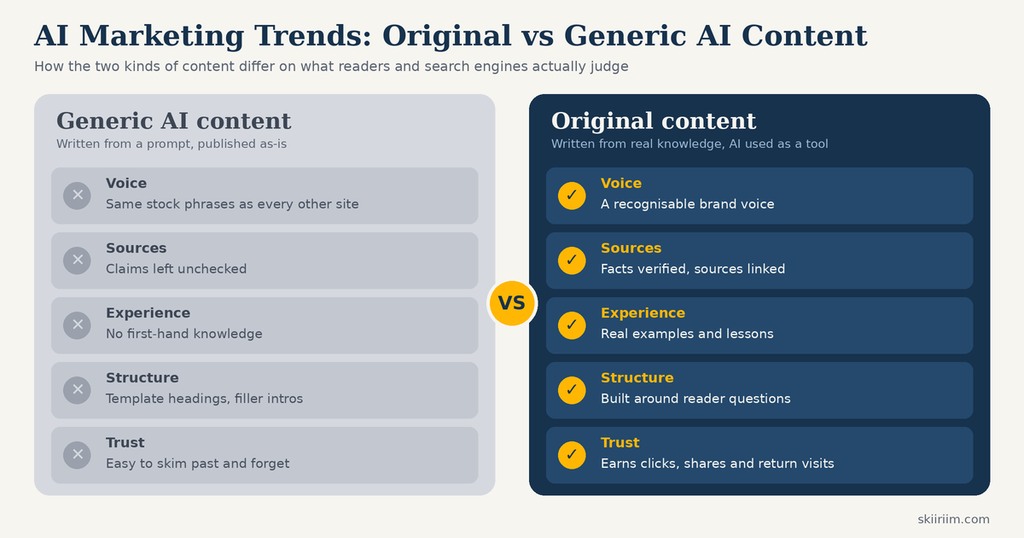
Trend 4: Content Volume Rises, So Sameness Becomes the Problem
When everyone can publish faster, more content looks alike. Onclusive’s 2026 survey analysis describes a homogenization problem. Marketers use similar tools trained on comparable data, so output drifts toward the average.
HubSpot’s survey points the same way. It reports that 62.7% of marketers believe more unique, human-centered content is needed to compete with AI content.
What Stands Out in the Current AI Marketing Trends
- First-hand experience and real examples
- Original data, even from a small survey
- A clear point of view, not a neutral summary
- Screenshots, photos and results you actually produced
Next step on this AI marketing trend: add one piece of original material to every important page. It can be a test result, a customer question or a lesson from a mistake.
Your firsthand note: [Give an example of content that performed well because it was original, and one that blended in.]
Trend 5: Personalization at Scale Meets Data Reality
Personalization at scale is a headline promise of generative AI. HubSpot reports that using AI to create personalized content is the number one trend marketers name for 2026.
The promise depends on data. Epsilon found that 45% of marketers cite incomplete or unreliable data as their top challenge. The Martech for 2026 summary, mentioned above, also reports that 56.3% name poor data quality.
Why Data Quality Decides the Outcome
AI can write a thousand versions of a message. If your customer data is wrong, it will personalize the wrong thing a thousand times.
- Clean your core fields first. Names, segments, purchase history and consent status.
- Collect data openly. Preference centres and surveys beat guesswork.
- Start small. Test personalization on one email or page before expanding.
- Respect privacy rules. Check the laws that apply to your audience.
Next step on this AI marketing trend: pick one segment and personalize one message for it. Measure the result before scaling.
Your firsthand note: [Describe a personalization test you ran, the data you used and what you learned.]
Trend 6: The Trust Gap and AI Disclosure
Advertisers and consumers see AI in ads very differently. The IAB’s January 2026 research reports that 82% of ad executives believe Gen Z and Millennials feel positive about AI-generated ads, while only 45% of those consumers actually do. The IAB also released an AI transparency and disclosure framework that month.
Other surveys show similar caution. A May 2026 YouGov survey of 1,046 Australian adults found that 45% would trust a brand less on discovering its ads were made mainly with AI. A June 2026 Clutch survey of 408 consumers found 55% felt less favorable once they detected AI in a brand’s creative, versus 24% more favorable.
Canva’s report, covered by The Next Web, adds that many consumers prefer human-made ads and want disclosure. Vendor-run surveys like this deserve extra scrutiny, but the direction matches the independent studies.
How AI Disclosure Can Help
AI disclosure is becoming a brand decision, not just a legal one. Clear, honest labels tend to work better than hiding AI use, and the evidence suggests consumers respond to proof of human craft.
- Disclose when AI creates people, voices or realistic images.
- Explain how humans reviewed and shaped the work.
- Keep a short public AI policy.
- Check the rules in each market, since requirements differ.
This is general information, not legal advice. Ask a qualified professional about the rules that apply to you. The same principle applies to paid links, which we cover in our guide to affiliate marketing.
Your firsthand note: [Share how you or your clients handle AI disclosure, and how audiences reacted.]
Trend 7: Marketing Roles Shift From Making to Supervising
As AI takes over drafts and reports, the human job moves toward direction, review and judgment. HubSpot’s survey data shows that 68.2% of marketers say they understand how to use AI, up from 47% the year before.
Onclusive’s survey found that around 60% of agency marketers expect AI to transform roles by automating reporting and analysis. HubSpot’s data also shows that about a third of respondents say AI saves them 10 to 14 hours a week, as reported in its AI predictions article.
Skills That Gain Value as AI Marketing Trends Mature
- Writing clear briefs and prompts
- Fact-checking and editing AI output
- Understanding data and customer needs
- Strategy, positioning and taste
- Managing risk, privacy and ethics
Next step on this AI marketing trend: write a short checklist for reviewing AI output, and make sure a person signs off before anything is published.
Your firsthand note: [Describe how your own role or workflow changed, and which skills you now rely on most.]
Trend 8: Measurement Moves Beyond Clicks
If AI answers reduce clicks, click counts alone tell an incomplete story. Epsilon’s conclusion is that value, not usage, is what matters now. That pushes teams to track more than traffic.
Better Signals to Track Across AI Marketing Trends
- Citations and mentions: whether AI tools name your brand or link to your pages.
- Branded searches: people searching for you by name.
- Assisted conversions: sales that began with content someone read earlier.
- Quality of leads: not only how many.
- Time saved versus quality: to judge whether AI really improves your work.
Pew’s finding that few visitors click the sources inside an AI summary is a reminder. Being cited may build awareness even without a click, though the effect is hard to measure.
Next step on this AI marketing trend: once a month, ask a few AI assistants your top ten customer questions. Record which sources they cite, then compare the results month to month.
Your firsthand note: [Share what you measure now, and any surprising result from tracking citations or branded searches.]
Putting These AI Marketing Trends Into Practice
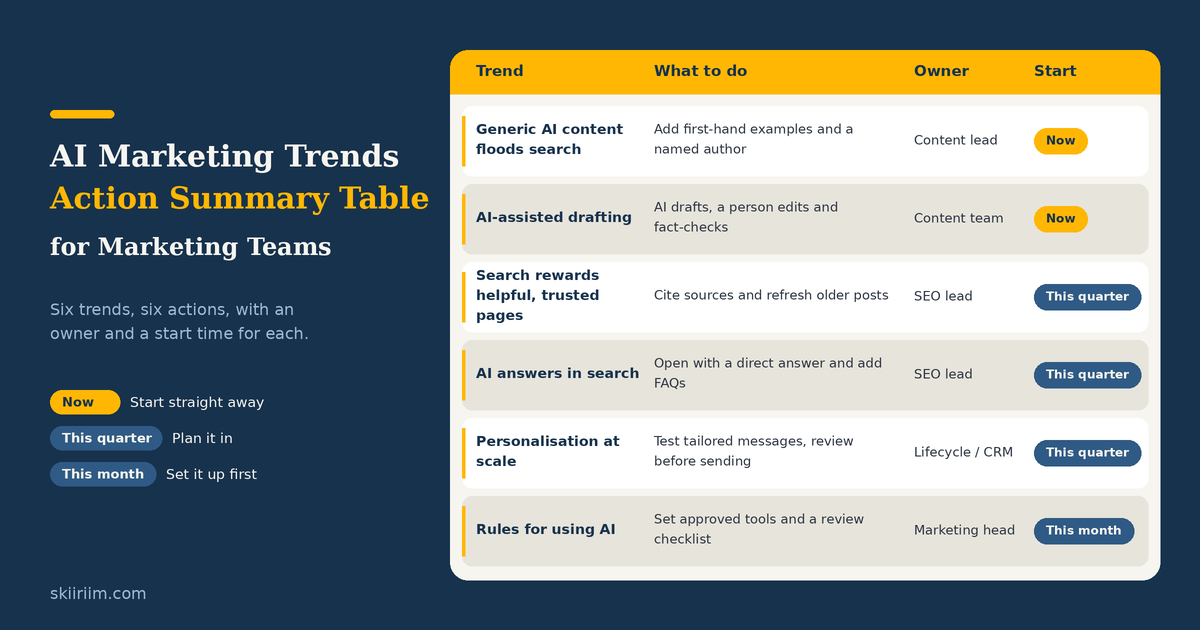
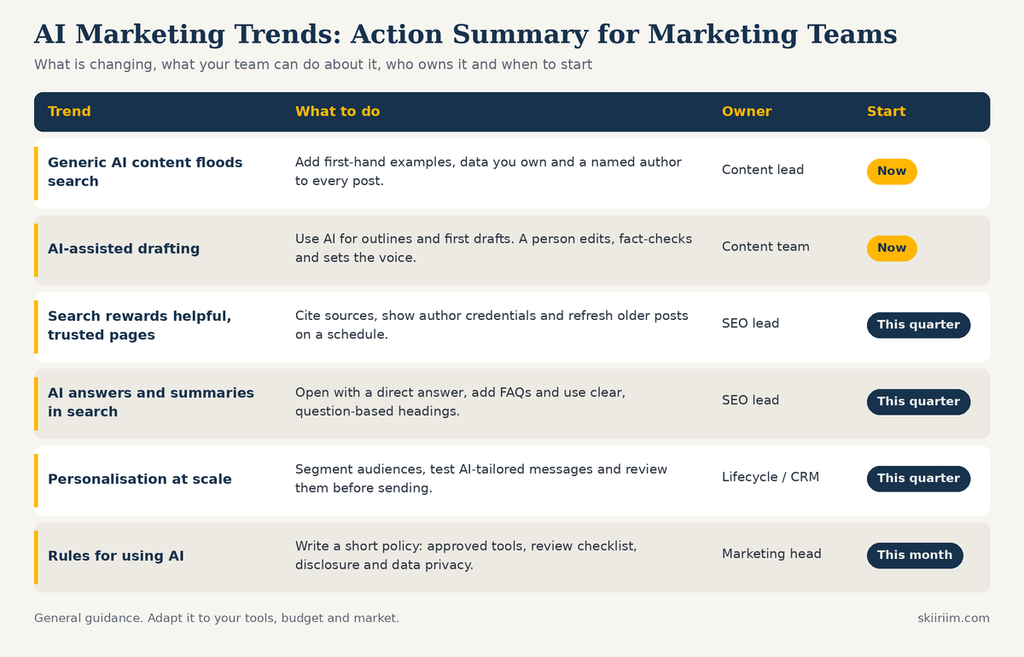
Eight trends can feel like a lot. This table shows the one move to make for each.
You do not need to act on every one of these AI marketing trends at once. Choose the two that matter most for your goals and start there.
A content site might focus on trends 2, 4 and 8. A team that runs paid campaigns might care most about trends 5 and 6. The right order depends on where your audience finds you and how much they trust you.
| Trend | Evidence in brief | Your first move |
| 1. AI as baseline | Near-universal use, data quality a top blocker | Audit where AI really improves results |
| 2. AI search | Fewer link clicks when summaries appear | Write clear, citable answers |
| 3. AI agents | Wide use, limited production | Pilot internally with approvals |
| 4. Sameness | Marketers want more human-centered content | Add original proof to key pages |
| 5. Personalization | Top trend, held back by data | Clean data, test one segment |
| 6. Trust and disclosure | Consumers more skeptical than advertisers expect | Publish an AI policy |
| 7. Roles | Skills and workflows shifting | Create a review checklist |
| 8. Measurement | Clicks tell only part of the story | Track citations monthly |
A Hypothetical Example
This is an invented example, not a real case study.
Imagine a three-person agency. It uses AI for first drafts and reporting, which saves each person several hours. It adds a human review step and a short “how we use AI” page. It also tracks which AI assistants cite its guides.
The agency cannot be sure what causes any change in leads. But it now knows what it is measuring, which is where useful learning starts.
What to Watch Next in AI Marketing Trends
This section is my reading of where the evidence points, not a forecast backed by data. Treat it as a list of questions worth tracking.
- Will AI search keep reducing clicks? Re-check your own analytics each quarter instead of relying on one study.
- Will disclosure rules tighten? The IAB framework and consumer surveys suggest pressure is growing, but local laws differ.
- Will agents reach production? Watch whether pilots turn into reliable, supervised workflows.
- Will original content gain more weight? The “sameness” problem suggests proof and experience will matter more.
The best way to stay ahead of AI marketing trends is to keep a simple learning loop. Test something small, record the result, and share what you learn with your team.
Checklist: Is Your Team Ready for These AI Marketing Trends?
- ☐ We know which tasks AI helps and which it does not.
- ☐ Our key pages answer questions clearly and include original proof.
- ☐ We test agents in low-risk workflows with human approval.
- ☐ Our customer data is clean enough to personalize safely.
- ☐ We have a written AI policy, including disclosure rules.
- ☐ A person reviews and fact-checks AI output before it is published.
- ☐ We track citations, branded searches and assisted conversions.
- ☐ We review the rules in each market where we advertise.
5 Mistakes to Avoid
Mistake 1: Treating Usage as Success
Using AI tools proves nothing about results.
Fix: tie each use of AI to a measurable outcome.
Mistake 2: Publishing Unreviewed AI Content
Errors and generic wording damage trust.
Fix: require a human edit and fact-check on everything.
Mistake 3: Letting Agents Act Unsupervised
Mistakes can reach customers at speed.
Fix: begin with internal tasks and keep approvals in place.
Mistake 4: Hiding AI Use
Consumers who feel deceived lose trust faster.
Fix: choose a clear, honest disclosure approach.
Mistake 5: Ignoring Data Quality
Poor data produces confident but wrong personalization.
Fix: clean and check your core data before scaling.
Your 30-Day Action Plan
📅 Week 1: Audit
- ☐ List every AI tool your team uses and what it is for
- ☐ Note where results improved and where they did not
- ☐ Check the quality of your customer data
📅 Week 2: Content and Search
- ☐ Choose five key pages to improve
- ☐ Add direct answers and original proof to each
- ☐ Run your first AI assistant citation test
📅 Week 3: Governance
- ☐ Write a short AI use and disclosure policy
- ☐ Create a review checklist for AI output
- ☐ Pilot one AI agent on an internal task
📅 Week 4: Measure and Decide
- ☐ Compare citation results with week 2
- ☐ Review time saved against quality
- ☐ Decide what to scale, change or stop
FAQ
What are the biggest AI marketing trends in 2026?
Answer-first search, supervised AI agents, content sameness, personalization at scale, the consumer trust gap, shifting team roles and better measurement lead the research.
Is AI search killing organic traffic?
Not simply. Pew’s 2025 study found fewer link clicks when an AI summary appeared, but results vary by query and site. Track your own data.
Are AI agents ready for marketing teams?
They are useful for supervised tasks. Surveys suggest many teams use them while few run them fully in production.
Do I have to disclose AI use in marketing?
Rules differ by country and platform. Industry bodies, such as the IAB, are publishing frameworks. Check local requirements and consider honest disclosure as a trust signal.
How do I measure results if clicks fall?
Add citations, branded searches, assisted conversions and lead quality to your dashboard.
Is it safe to rely on personalization at scale?
Only with good data and privacy care. Start with one segment and test.
How often do AI marketing trends change?
Quickly. Tools, search features and consumer attitudes shift every few months, so re-check the data and your own results regularly.
Which AI marketing trends matter most for small businesses?
For most small businesses, the strongest priorities are original content, honest AI disclosure and clean customer data. Start there before chasing advanced automation.
How much AI content is too much?
There is no fixed number. If content lacks original value or human review, it will struggle to stand out, whatever the proportion.
Conclusion: Use the Data, Add Your Own Proof
These AI marketing trends point the same way. AI speeds up the work, so trust, originality and judgment decide who wins.
The most reliable way to benefit from AI marketing trends is to pick one, run a small test and record what you learn. Your own results will be worth more to your audience than any number quoted here.
If you want help building a fast, credible website that earns citations and clients, get in touch with our team.
📚 Sources and Resources
- HubSpot: 2026 State of Marketing data
- HubSpot: AI marketing predictions for 2026
- Epsilon: 2026 benchmark study on AI in marketing
- Pew Research Center: clicks and AI summaries
- IAB: AI Transparency and Disclosure Framework
- YouGov: Australians and AI-generated ads
- Onclusive: marketing trends 2026
- Google Search Central: AI features and your website