

Affiliate marketing is legit. Real companies pay real commissions to people who send them customers. But “legit” and “worth your time” are two very different questions.
Plenty of people earn a solid income from affiliate marketing. Plenty of others spend months writing posts and earn nothing. The difference is rarely luck.
This guide gives you the honest picture: how the model works, what it really costs in time, where beginners go wrong and how to decide if it suits you. You will not find invented income screenshots or “quit your job in 30 days” promises here.
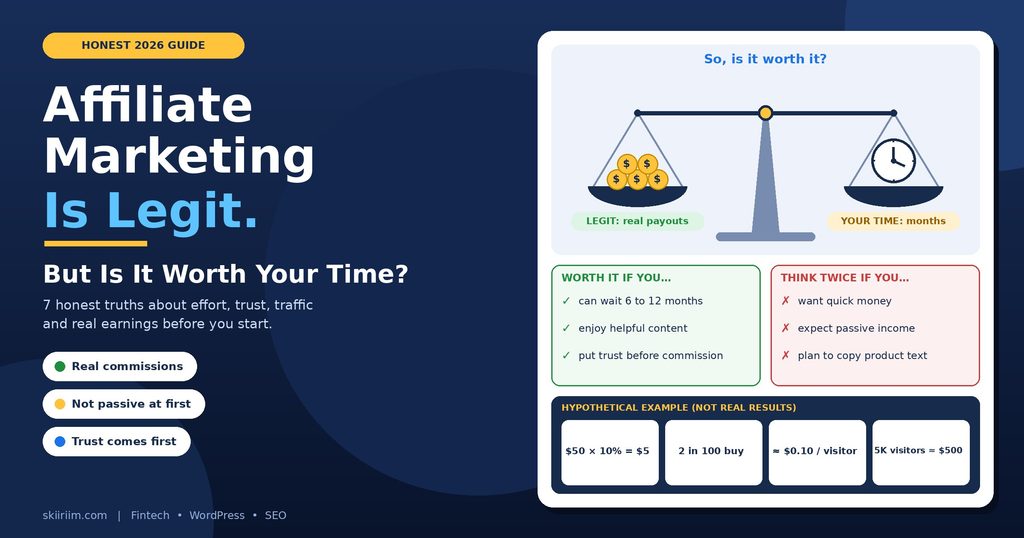
The short answer: affiliate marketing is worth your time if you enjoy creating genuinely helpful content, can wait months for results and are willing to build trust with an audience. It is a poor fit if you want quick, effortless money.
Why Everyone Asks If Affiliate Marketing Is Worth It
The pitch sounds perfect. You recommend products, people buy through your link and you earn a commission. No stock, no shipping, no customer support.
Then reality arrives. Most beginners publish a few posts, see almost no traffic and quit. Others chase the wrong products or copy manufacturer descriptions and never get found.
The problem is not that affiliate marketing does not work. The problem is that the work is hidden behind the marketing. Someone has to find an audience, earn its trust and give it a reason to click.
That is why this article is built around seven truths. Read them before you spend money on hosting, courses or tools.
Table of Contents
Truth 1: Affiliate Marketing Is Legit, and Here Is How You Get Paid
Affiliate marketing is a performance-based arrangement. A business pays you a commission when someone you referred takes an action, usually a purchase.
How Affiliate Marketing Works Step by Step
- You join an affiliate program, either run by a company or through a network.
- You receive a unique tracking link.
- You share that link inside helpful content, such as a review, a comparison or a tutorial.
- A reader clicks, and a tracking cookie records the referral.
- If the reader buys within the program’s time window, you earn a commission.
The Main Ways You Can Earn
- Pay per sale: a percentage or fixed amount when a purchase is made.
- Pay per lead: a payment when someone signs up, requests a quote or starts a free trial.
- Recurring commission: ongoing payments while a customer keeps a subscription. Some software programs work this way.
- Pay per click: a small amount for traffic. This is now less common.
The model is legitimate because everyone involved benefits. The company gets a customer, the reader gets a recommendation and you get paid for the introduction.
Watch out for lookalikes. Real affiliate marketing never asks you to pay a large fee to “unlock” commissions or to recruit others as the main way to earn. Those are pyramid-style schemes, not affiliate programs.
Truth 2: It Is Not Passive Income at the Start
Affiliate marketing can become semi-passive later. A well-ranked article can keep earning for months or years.
But the early stage is the opposite of passive. You research, write, edit, publish, promote, measure and update. All of that happens before you see meaningful commissions.
What the Work Really Includes
- Choosing a topic and studying what your audience needs
- Testing or researching products honestly
- Writing detailed, original content
- Building a site or channel and keeping it fast and secure
- Promoting your content and earning links or followers
- Tracking results and improving what underperforms
Think of it as building a small media business. The commission is the revenue model, not the job.
A useful mindset: treat your first six to twelve months as an investment of time, not a source of income. If you can afford that, affiliate marketing becomes far less stressful.
Truth 3: Your Niche and Audience Matter More Than the Program
Beginners often start by asking which affiliate program pays the most. A better question is which audience you can serve better than anyone else.
A high commission means nothing if nobody trusts your recommendation. A modest commission is fine if you serve a specific audience well.
How to Choose an Affiliate Marketing Niche
- Start with experience. What do you already know, use or have solved for yourself?
- Look for buying intent. People searching “best”, “vs”, “review” or “alternative” are often ready to decide.
- Check that products exist. Make sure reputable programs serve the niche.
- Be specific. “Tools for freelance writers” is easier to win than “software”.
- Stay interested. You will write about it for years.
Match the Product to the Reader
Only promote what you would honestly recommend to a friend. If you would not use it, do not sell it.
Recommending a product because it pays well but suits nobody destroys trust. Trust is the only real asset in affiliate marketing.
Truth 4: Trust and Disclosure Are Non-Negotiable
When you earn a commission from a link, that is a financial relationship your audience deserves to know about.
In the United States, the FTC’s endorsement guidance requires that this connection be disclosed clearly and conspicuously. A legal summary of the updated guidance explains that the disclosure should be easy to notice and placed close to the recommendation, not buried at the bottom.
Other countries have similar advertising rules, and affiliate programs often require disclosure in their own terms. Check the rules that apply where you and your audience live.
A Simple Disclosure Routine
- Put a short plain-language line near the top of any post with affiliate links.
- Example: “This post contains affiliate links. If you buy through them, I may earn a commission at no extra cost to you.”
- Repeat the disclosure in videos and social posts, close to the recommendation.
- Add a full affiliate disclosure page and link to it in your footer.
This is general information, not legal advice. If your income grows, speak to a qualified professional about your obligations.
Honest Reviews Convert Better Anyway
Readers can sense hype. Mention real downsides, say who a product is not for and explain how you tested it. A balanced review earns more trust, and trust leads to more clicks over time.
Truth 5: Thin Content Will Not Rank
The fastest way to fail at affiliate marketing is to publish thin pages. These are pages that copy a manufacturer’s description, add a link and offer nothing new.
Google’s spam policies treat thin affiliate pages with little original value as a problem. This overview of thin content explains that such pages fail to help users, and points to Google’s guidance on writing high-quality reviews.
What Helpful Affiliate Content Looks Like
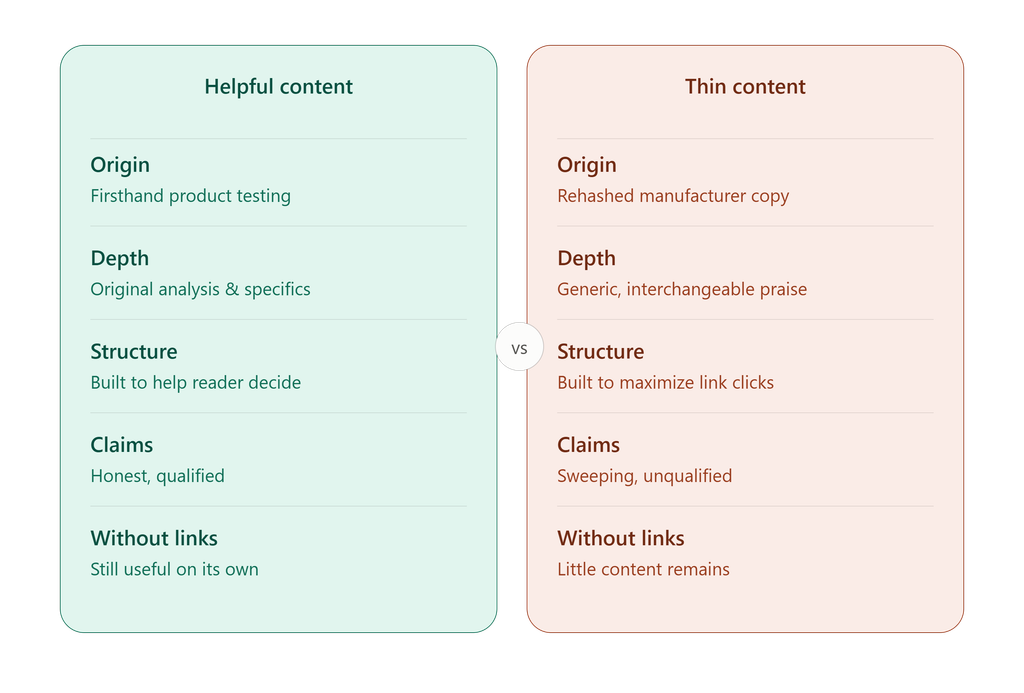
Google’s review guidance, as summarized by Practical Ecommerce, favors content that shows real experience. In practice, that means:
- First-hand use, with your own photos, screenshots or short videos
- Clear pros and cons based on what you actually experienced
- Comparisons with alternatives, so readers can choose
- Your reasoning for recommending one option over another
- More than one buying option where it makes sense
If your page could have been written by someone who never touched the product, it will struggle.
Content Types That Work Well
- Honest single-product reviews
- Head-to-head comparisons (“X vs Y”)
- Best-for lists that explain who each option suits
- Tutorials that use a product to solve a real problem
- Case notes from your own testing
Truth 6: Traffic Takes Time, So Pick One Channel
Affiliate marketing needs people to see your content. Where they find it depends on the channel you choose.
Common Channels for Affiliate Marketing
| Channel | Speed to results | Main strength | Main challenge |
| Blog with SEO | Slow | Content keeps earning long-term | Months before rankings arrive |
| YouTube | Slow to medium | Builds strong trust through demonstration | Higher production effort |
| Email newsletter | Medium | Direct access to your audience | You must first build a list |
| Social media | Fast to start, unpredictable | Quick feedback and reach | Content disappears quickly, platform rules change |
| Paid ads | Fast | Immediate traffic | Easy to lose money, and some programs restrict it |
Choose one primary channel and stay with it long enough to learn it. Spreading yourself across five platforms usually means mastering none.
Why SEO Suits Many Beginners
A search-driven blog costs little to start and rewards patience. People searching for a product comparison are already close to a decision, which suits affiliate marketing well.
Building that audience takes structure and consistency. Our guide to AI search optimization explains how to make your pages easier to find and cite, and the same habits help affiliate content.
Truth 7: The Real Math Decides Whether It Is Worth It
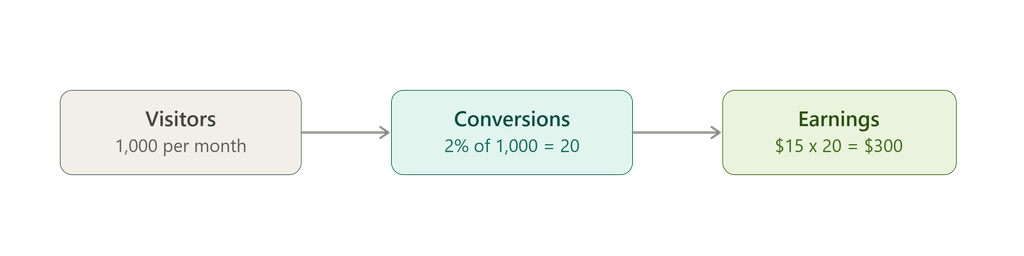
Whether affiliate marketing is worth your time comes down to arithmetic. Let’s use a simple, hypothetical example. These numbers are illustrations, not typical results. Real commission rates and conversion rates vary widely.
Hypothetical example:
- A product costs $50 and pays a 10% commission, so each sale earns $5.
- Suppose 2 in every 100 visitors who read your review buy it.
- That is 2 sales per 100 visitors, or $10, which is about $0.10 per visitor.
- To earn $500 a month, you would need around 5,000 visitors reading that kind of content.
Now compare that with the time it takes to attract 5,000 monthly visitors. For a new site, that can take many months of steady publishing.
Ask These Questions Before You Commit
- How many hours can I give each week? Consistency matters more than intensity.
- How long can I go without income? Plan for at least six to twelve months.
- What will it cost? Hosting, a domain, tools and possibly a course or two.
- What is my earning per visitor likely to be? Higher-priced products and recurring commissions improve the math.
- Do I enjoy the work? Enjoyment keeps you going when results are slow.
Ways to Improve the Math
- Promote higher-value or recurring-commission products you truly believe in.
- Target readers with buying intent, not just curiosity.
- Improve your reviews so more readers trust and click.
- Build an email list so you can reach readers more than once.
- Update your best-performing posts regularly.
How Affiliate Marketing Compares With Other Ways to Earn Online
To judge whether affiliate marketing is worth your time, compare it with the alternatives. Each option trades speed against scale.
| Option | Speed to first income | Scales beyond your hours? | Main trade-off |
| Freelancing or services | Fast | Limited | You are paid for your time |
| Affiliate marketing | Slow | Yes | Months of unpaid work first |
| Selling your own products | Medium to slow | Yes | You handle creation, support and refunds |
| Display advertising | Slow | Yes | Needs large traffic for meaningful income |
Affiliate marketing sits in the middle. It is slower than freelancing but avoids the product creation and customer support that come with selling your own goods.
Many successful creators combine them. They use freelancing or client work to pay the bills while affiliate marketing income grows in the background.
If you already offer a service, affiliate marketing can also complement it. You recommend tools your clients need, and both income streams support each other.
How to Start Affiliate Marketing With Little Money
You do not need a large budget to test whether affiliate marketing suits you. You need a clear plan and a willingness to keep costs low until you have evidence.
- Validate your niche first. Write your first ten helpful posts or videos before you pay for anything beyond the basics.
- Keep the setup simple. A domain, reliable hosting and a clean theme are enough to begin.
- Use free tools. Search Console, Trends and a basic spreadsheet cover most early needs.
- Delay expensive courses. Learn from free guides, official documentation and your own experiments first.
- Track your time. Note the hours you spend each week so you can judge the return honestly later.
- Reinvest slowly. When commissions arrive, spend on the tools that clearly save you time.
The biggest cost in affiliate marketing is not money. It is the months of consistent effort. If you protect your time and stay consistent, a small budget is enough.
A warning about “guru” offers: anyone selling a costly course by promising guaranteed affiliate marketing income deserves skepticism. Ask for verifiable evidence, read independent reviews and remember that the person selling the course often earns more from the course than from the method.
Who Affiliate Marketing Is Right For
Here are three illustrative profiles. They are examples to help you think, not real case studies.
Profile A: The Patient Builder
This person has a steady job and can spare eight to ten hours a week. They pick a topic they know and publish thorough posts. Their affiliate marketing income starts small but grows as their content matures. This is the profile that usually succeeds.
Profile B: The Expert With an Audience
This person already has readers, followers or clients. They recommend tools they genuinely use. Because trust already exists, results can arrive faster. For them, affiliate marketing is an extra income stream, not a new business.
Profile C: The Quick-Money Seeker
This person wants results in weeks and expects passive income right away. They copy descriptions and chase the highest commissions. This is the profile most likely to be disappointed.
The honest verdict: if you are Profile A or B, affiliate marketing is very likely worth your time. If you are Profile C, adjust your expectations first, or consider a faster option such as freelancing or offering a service.
Tools and Platforms for Affiliate Marketing
You do not need many tools. Here are the useful ones. Availability and payout methods differ by country, so check each program’s terms before joining.
| Tool | Cost | Best For |
| Google Search Console | Free | Seeing which searches bring visitors to your content |
| Google Trends | Free | Comparing interest in products and topics |
| Amazon Associates | Free to join | Physical products with a wide catalog |
| CJ Affiliate | Free to join | A network with many brands in one place |
| PartnerStack | Free to join | Software and SaaS programs, often recurring |
| A WordPress site with an SEO plugin | Hosting and domain costs | Owning your platform and audience |
Never pay large upfront fees to join a legitimate program. Real networks and company programs are generally free to join.
If you need a fast, well-built WordPress site to publish on, our team can help. See our contact page to talk about your project.
Quick Checklist: Is Affiliate Marketing Worth It for You?
Answer these honestly. The more you tick, the better your odds with affiliate marketing.
- ☐ I can give a few hours every week for at least six months.
- ☐ I can afford to earn little or nothing during that period.
- ☐ I know a topic well enough to help beginners with it.
- ☐ I am comfortable disclosing my affiliate links openly.
- ☐ I would rather give honest advice than make a quick sale.
- ☐ I enjoy writing, filming or teaching, not just earning.
- ☐ I am willing to test products and share real results.
- ☐ I will track my numbers and change course when the data says so.
If you ticked six or more, affiliate marketing is probably a good fit. If you ticked fewer than four, spend more time on the basics first, or pick a faster way to earn while you build skills.
This checklist is a thinking tool, not a guarantee. Your niche, effort and timing all shape the outcome of affiliate marketing, so treat your first year as an experiment and let real data guide your next move.
5 Affiliate Marketing Mistakes to Avoid
Mistake 1: Promoting Products You Have Not Researched
Recommending something blindly risks your reputation.
Fix: research thoroughly, use the product where you can and say plainly what you did and did not test.
Mistake 2: Skipping Disclosure
Hidden affiliate links damage trust and can break program rules or advertising law.
Fix: disclose clearly near your links and keep a disclosure page.
Mistake 3: Publishing Thin Content
Copied descriptions and link-only pages give search engines no reason to rank you.
Fix: add original experience, comparisons and evidence to every page.
Mistake 4: Chasing Every Platform
Being everywhere at once means being good nowhere.
Fix: choose one main channel and stick to it for at least six months.
Mistake 5: Giving Up Too Early
Most content needs time before it earns.
Fix: set a review point at six and twelve months, measure honestly and adjust instead of quitting after a few weeks.
Your 12-Month Affiliate Marketing Roadmap
📅 Months 1-2: Foundation
- ☐ Choose your niche and your primary channel
- ☐ Set up your site, About page and disclosure page
- ☐ Join two or three suitable affiliate programs
- ☐ Set up Google Search Console and analytics
- ☐ Write down 20 questions your audience asks
📅 Months 3-4: First Content
- ☐ Publish one thorough review or comparison each week or two
- ☐ Add your own photos, tests or screenshots
- ☐ Add clear disclosures near every affiliate link
- ☐ Link related posts together
📅 Months 5-7: Grow and Improve
- ☐ Check Search Console for which posts gain impressions
- ☐ Improve titles and opening paragraphs on early posts
- ☐ Start an email list with a useful free resource
- ☐ Publish comparison and “best for” pages
📅 Months 8-10: Build Authority
- ☐ Publish original research, tests or tutorials
- ☐ Begin honest outreach for guest posts or mentions
- ☐ Update your best posts with fresh information
- ☐ Review which programs and products actually convert
📅 Months 11-12: Review and Decide
- ☐ Calculate hours spent, costs and commissions earned
- ☐ Work out your earnings per visitor
- ☐ Double down on what works and drop what does not
- ☐ Decide whether to scale, adjust or stop
FAQ About Affiliate Marketing
Is affiliate marketing legit or a scam?
Affiliate marketing itself is a legitimate business model. Scams tend to be courses or schemes that use the label, demand big upfront payments or make guaranteed-income claims.
How much can you earn from affiliate marketing?
It varies enormously. Some people earn nothing, some earn a modest side income and some build full-time businesses. Anyone quoting a typical figure without evidence should be treated with caution.
How long does it take to earn your first commission?
It depends on your channel, niche and effort. Many beginners wait several months for meaningful results, particularly with search-based blogs.
Do you need a website to do affiliate marketing?
No, but a site you own gives you control. You can also use YouTube, email or social media, though platform rules and reach can change.
Do you need money to start?
You can start cheaply with a domain, hosting and free tools. Avoid expensive courses until you have tested the basics yourself.
Do you have to disclose affiliate links?
In many places, yes. Disclose clearly and close to the recommendation, and check the rules where you and your readers live.
Can you do affiliate marketing without an audience?
You can start with none, but you need to build one. Helpful content that solves specific problems is the usual route.
Conclusion: Is Affiliate Marketing Worth Your Time?
Affiliate marketing is legit, and it can be worth your time. But it rewards patience, honesty and real usefulness far more than clever tricks.
If you can invest months before seeing income, serve a specific audience and put trust before commission, it is a strong long-term skill. If you want quick, hands-off money, it will disappoint you.
Start small. Pick one niche, one channel and one honest review. Track your results for six months, then decide with real data instead of hype.
📚 Resources Mentioned
- FTC endorsement guidance summary – What clear and conspicuous disclosure means.
- Semrush: thin content explained – Why thin affiliate pages struggle.
- Practical Ecommerce: Google’s review guidance for affiliates – What helpful reviews include.
- Google Search Console – Free search performance data.
- Google Trends – Free interest comparisons.